
NLP 4 Good
New Methods for Multimodal Analysis of Political Communication in Algorithmic Social Media
Keywords:
multimodal analysis · computational social science · political communication · algorithmic social media · short-form video · sentiment analysis · user engagement · online discourse
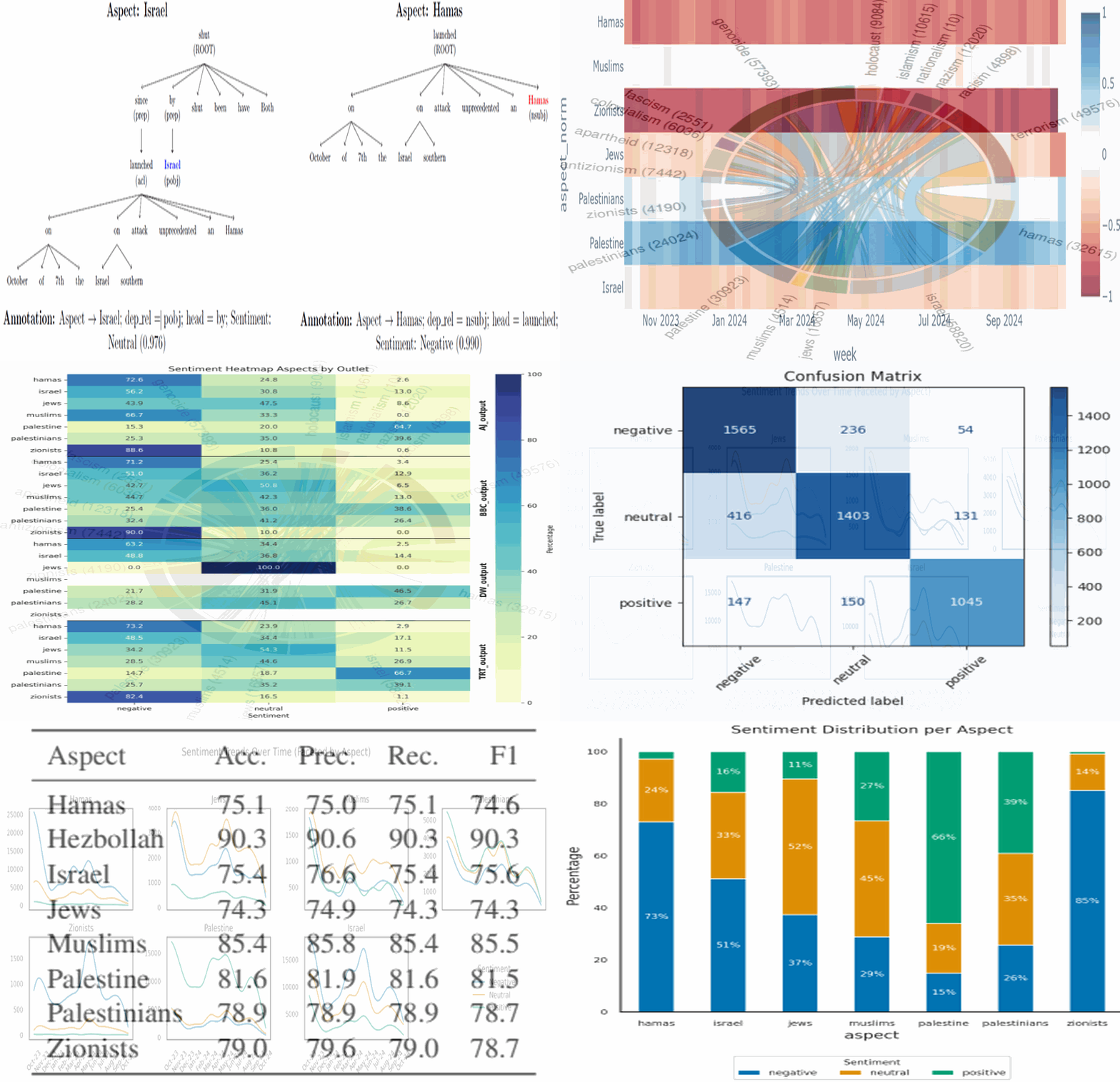
When conducting research on online discourse, scholars often ask two questions: how much antisemitism is present, and how it can be measured. However, many factors that shape why certain narratives gain traction online receive less attention. This project addresses this gap by examining forms of online discourse that primarily drive user engagement on social media, with particular attention to the role of emotional toning.
The project conducts empirical research on how social narratives circulate online by analyzing international news content on social media platforms. It focuses on state-funded and state-supported outlets such as Al Jazeera, the BBC, Deutsche Welle, and TRT World. Using longitudinal analysis, the project measures the proportionality and dynamics of content related to the aftermath of the Israel–Hamas war since October 7, 2023.
Empirical Studies
To date, the project comprises four empirical studies:
Study 1: Investigating Polarization in YouTube Comments via Aspect-Based Sentiment Analysis
Proceedings of the 15th International Conference on Recent Advances in Natural Language Processing – Natural Language Processing in the Generative AI Era Download paper
This study uses aspect-based sentiment analysis (ABSA) to analyze polarization in online discourse based on more than three million user comments and replies from YouTube Shorts. A manually annotated subset is used to train and evaluate a domain-adapted ABSA model. The results show that fine-grained sentiment analysis provides reliable insights into how politically and ideologically charged topics are discussed over time and across outlets.
Study 2: Analyzing Polarization in Online Discourse on the 2023–2024 Israel–Hamas War
Proceedings of the 21st Conference on Natural Language Processing (KONVENS 2025): Workshops, pages 7–16, Hannover, Germany Download paper
This study applies large-scale sentiment analysis to the same corpus to track longitudinal changes in user attitudes over the course of one year. The analysis shows that aggregate sentiment trends reflect reactions to geopolitical developments, while also demonstrating that meaningful interpretation requires the combination of automatic analysis with domain-specific expertise.
Study 3: Mapping Affective Polarization in YouTube Shorts: A Data-Driven Analysis of Political Communication During the 2023–2024 Israel–Hamas War (under review)
This study examines affective polarization in user responses to short-form news content published by state-funded media outlets. The analysis reveals systematic differences in sentiment toward key geopolitical and ideological entities, with disproportionately negative evaluations of Israel and Zionism, contrasted with more positive or sympathetic evaluations of Palestine and Palestinians. These patterns indicate polarized evaluative dynamics in audience reactions. The study further discusses how affective narratives and emotionally charged language shape political communication in Web 2.0 environments.
Study 4: How to Investigate Short-Form Video Content: A Pipeline for Multimodal Analysis (under review)
This study shifts the analytical focus to the videos themselves by examining audio and visual layers of short-form news content. It introduces a multimodal pipeline that combines automatic transcription, sentiment analysis, and visual scene classification to analyze variation in sentiment and framing across outlets and over time.
Further Research Outputs
The project is in the process of releasing a curated dataset that supports replication and enables further research on short-form news coverage and online discourse.